1. Useful links
1. 1. Tutorials and history of tensor networks
- The tensor network by Miles Stoudenmire et al. : an overview of existing algorithms, methods and tutorials. https://tensornetwork.org/
- The DMRG (tensor network) website by Tomotoshi Nishino : up-to-date arXiv list and historical perspective on tensor networks. http://quattro.phys.sci.kobe-u.ac.jp/dmrg.html
1. 2. Conferences and networks
- Benasque Entanglement in strongly correlated systems (every year around Feb/ March): https://www.benasque.org/2023scs/
- The European Tensor Network : organizing yearly tensor networks schools for easy onboarding, and hosting recordings of colloquia held during the pandemic. https://nextcloud.tfk.ph.tum.de/etn/
- The International Quantum Tensor Network: a program which funded a series of workshops in the field. https://iqtn.phys.strath.ac.uk/
1. 3. Libraries
- iTensor https://itensor.github.io/ITensors.jl/dev/ (julia, also available in C++). See also the ITensor discourse which brings extremely helpful insight https://itensor.discourse.group/.
- TenPy https://tenpy.github.io/ (tensor networks in python)
- Tensor4all https://tensor4all.org/ (c++/python or julia)
1. 4. Introductions to tensor networks
Again, see https://tensornetwork.org/ for an exhaustive list of resources.
- Comprehensive introduction with link to the original formulation by S. White :
Ulrich Schollwöck,The density-matrix renormalization group in the age of matrix product states, Annals of Physics, 326, (2011) https://doi.org/10.1016/j.aop.2010.09.012.
- A video introduction by Philippe Corboz : https://www.youtube.com/watch?v=xt09nKMKd6M
2. Algorithms for 2D classical systems
It is possible to write partition functions of Hamiltonians for spins on a lattice as a tensor network contraction. I give a few elements below, but see notably the review:
Okunishi et al., Prog. Theor. Exp. Phys. 023A02 (2023), https://arxiv.org/pdf/2111.12223
I also provide an introduction to tensor networks for classical Ising models in my PhD thesis, in chapter 1.3 and appendix B (which I attempted to make pedagogical). In Chapter 2 of my thesis, focus on the case of frustrated Ising models.
2. 1. Writing a partition function as a tensor network
Given a short-range 2D classical Hamiltonian, we can write its partition function as a 2D tensor network.
The essential idea is to associate a local tensor (called T here) to each Boltzmann weight. In Chapter 1.3. of my thesis, I provide an overview of this approach.
The two essential sketches are shown below. Fig. 1.5. demonstrates how the partition function of the 1D Ising model can be written as a tensor network, and Fig. 1.6 how to extend this to the 2D square lattice Ising model.
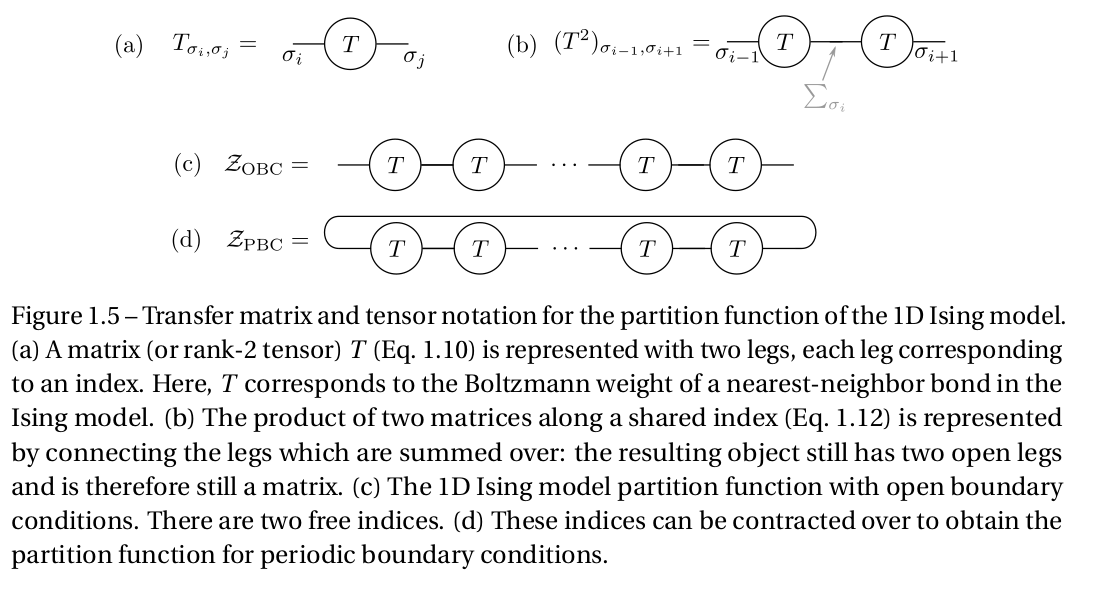
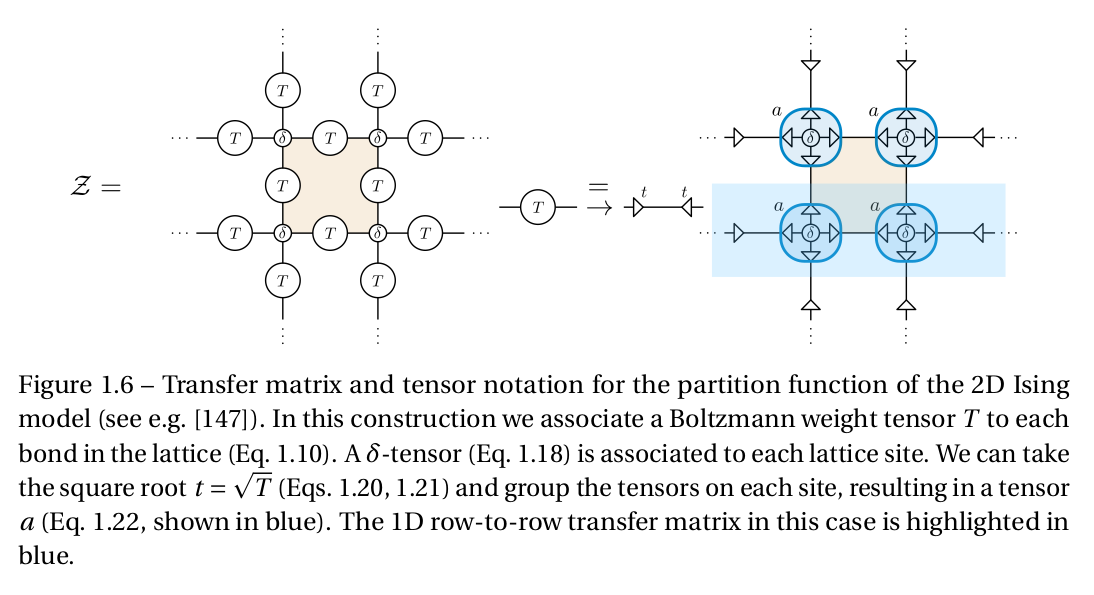
Once the partition function is obtained, one still has to evaluate it. In 1D this is simply done by diagonalizing the Boltzmann weight (or transfer) matrix, but in 2D, the transfer matrix is of infinite size in the thermodynamic limit. How should one proceed ? I mention some strategies below.
2. 2. Three main approaches for contracting the partition function
There are, in spirit, three main strategies to contract infinite 2D partition functions written as tensor networks:
- Boundary MPS approach : Looking for the leading eigenvector from the top/bottom/left/right. This is done with iTEBD or, better, with VUMPS or iDMRG.
- Corner-transfer matrix : inspired by the work of Baxter, this approach consists in looking for an environment for the central cite with a fixed-point algorithm.
- Tensor network renormalization group : this approach is the actual real-space renormalization group approach. The original algorithm by Levin and Nave is easy to understand and implement but it has some fundamental flaws in terms of the properties of the entanglement spectrum that it converges to. These can be fixed either by higher-order TRG approaches, or by the TNR algorithm.
Below, I list some references for these strategies.
2. 3. Corner transfer matrices : an origin of tensor networks
In the context of classical spin systems, tensor network techniques can be seen quite transparently as an extension of existing transfer matrix approaches, going back all the way to Kramers and Wannier's works and Onsager and Kaufmann's papers in the 1940's, followed by Fisher, Kasteleyn and Baxter's work in the 1960s and 1970s. Reading these works with the language of tensor networks in mind, one seems to spot tensor network ideas everywhere.
In particular, the corner transfer matrix renormalization group approach of Nishino and Okunishi found its origin in a re-exploration of Baxter's corner transfer matrix in the language of DMRG.
Main Idea : The goal here is to find a strategy to approximate well the environment of a single tensor / site using a matrix product of a few tensors.
Key papers are mentioned below, but I would like to highlight Samuel Nyckees's PhD thesis which provides a thorough introduction as well as an extension to the honeycomb lattice.
- Baxter 1968, https://doi.org/10.1063/1.1664623: this is where he came up with the ideas behind both VUMPS and CTMRG.
- Baxter 1978 : https://doi.org/10.1007/BF01011693 the first tensor network equations!
- Nishino & Okunishi 1996 https://journals.jps.jp/doi/10.1143/JPSJ.65.891 (classical)
- Orus & Vidal 2009 https://doi.org/10.1103/PhysRevB.80.094403 (for quantum systems)
2. 4. Boundary MPS approaches
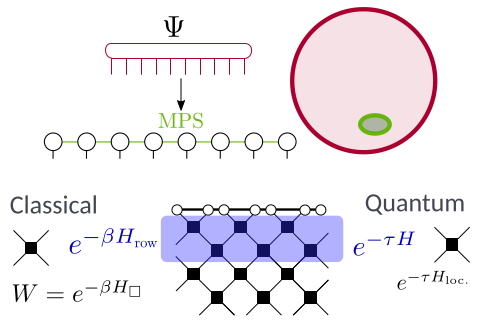
Main Idea : The goal here is to approximate the leading eigenvector of the row-to-row transfer matrix in the form of a Matrix-Product-State. Namely, we leverage all the well-controlled tools developped for the study of quantum 1D systems and apply them to infinite row-to-row transfer matrices. There are two main ways to do this, either using imaginary time-evolved block decimation or variational unifor matrix product states.
Variational uniform matrix product states or VUMPS:
- Zauner-Stauber, Vanderstraeten, Fishman, Verstraete,Haegeman 2018 https://doi.org/10.1103/PhysRevB.97.045145 .
- Fishman et al. 2018,https://doi.org/10.1103/PhysRevB.98.235148 (also for CTMRG).
- Nietner et al. 2020,https://doi.org/10.22331/q-2020-09-21-328
- Vanderstraeten, Haegeman,Verstraete, SciPost Phys. Lecture Notes, (2019) (in my opinion the best introduction to VUMPS)
iTEBD:
A direct extension of the groundbreaking work by Vidal for 1D quantum systems.
Its main quality is the easy "onboarding" if you want to start coding TNs.
- Orus, Vidal: https://arxiv.org/abs/0711.3960. the published version has some mistakes in the figures explaining the algorithm. The correct version is in the 2009 arXiv version (v4).
2. 5. Real space renormalization group using tensor networks
Main idea : use truncation of the tensors as a way to define a real-space renormalization group map. The original tensor renormalization group approach (TRG) has fundamental problems already highlighted by the authors in their original paper, and strategies have been devised to tackle these fundamental challenges. Nevertheless, despite its fundamental issues, TRG is perhaps the simplest tensor network algorithm one can write to study partition functions.
- TRG : M. Levin & C. Nave, Phys Rev Lett 99, 120601 (2007)
- Gilt-TNR : M. Hauru et al, Phys Rev B 97, 045111 (2018)
- See also a number of works by T. Xiang's group.
- Obtaining a correct RG flow : See recent works by S. Rychkov, N. Ebel and T. Kennedy
3. Partition functions of frustrated spin systems
In the case of frustrated spin systems, simply writing the partition function using Boltzmann weights on bonds can lead to numerical instabilities.
During my PhD, we contributed to highlight this problem and suggested a solution for a family of models, namely Ising models with farther-neighbor interactions. Others have shown how to extend this to XY models. Progress is still ongoing!
- Problem : Zhu and Katzgraber, https://arxiv.org/abs/1903.07721
- Problem and a solution for translation invariant models : B. Vanhecke, J. Colbois, et al. PhysRevResearch.3.013041 (2021)
- Problem and a solution for spin glasses : Liu et al, Phys Rev Lett. 126 090506 (2021)
- Application : J. Colbois, B. Vanhecke, et al. PhysRevB.106.174403 (2022)
- XY case : Song and Zhang, PhysRevB 108 224404 (2023)
- 3D case when the ground-state rule is well known : Vanderstraeten et al, PhysRevE 98 042145 (2018)