Research
Lines
Context: quantum matter and the many-body problem
The broad questions
We know very well four phases of matter: solid, liquid, gas, plasma. However, the wealth of different
phases (or states) of matter is much broader than these four. This corresponds to the many possibilities resulting of the
interactions of a huge number of ions and electrons in matter.
The broad questions of the field are:
(1) Can we understand the atomic-level structure of matter from its properties at our (macroscopic) scale?
(2) Conversely, can we predict the properties of matter at our scale by knowing its atomic-level structure?
For instance, our field has explained
- why diamond is transparent and extremely solid whereas graphite is dark and brittle, when they are both made of carbon
- that in the solid phase of water, the hydrogen atoms still have an exponential number of ways they can arrange even down to the lowest temperatures
The quantum many-body problem
Any little amount of matter visible to the naked eye contains order of 10²³ atoms. Even storing all the huge list of possible configurations of these atoms in a computer is impossible. To understand how the interactions between these atoms give rise to the macroscopic properties of matter, we need to find simpliciations of this many-body problem. Oftentimes, we have to take into account quantum properties of the atoms or electrons in the material: this is a quantum many-body problem.
The study of the many-body problem is not only relevant for understanding classical and quantum matter but for developing the computers of tomorrow, challenging the quantum computers of today, and asking the questions that they will solve.
Our work: quantum and classical magnetic systems
Even focusing only on the spins and the electrons of the atoms in a well-ordered lattice, i.e. a solid state material, a large variety of magnetic phases can be found, from simple magnets to spin liquids or topologically ordered states.
This abundance of phases stemming from strong correlations between electrons makes condensed matter an exciting field of study which is at the same time numerically and analytically challenging.
Ourvarious research projects focus on frustrated and disordered magnetic materials.
Frustration corresponds to an impossibility of locally accommodating all the constraints. It can give rise to fully disordered magnetic phases down to the lowest temperatures!
Disorder can also be present at the microscopic level in materials or in artificial quantum lattices. Such local impurities can completely prevent transport In our research, my collaborators and I develop and apply numerical tools to study frustration, disorder and their interplay. Our research is motivated both by materials and by experiments that emulate materials, such as artificial spin systems or cold atom gases.
Frustrated spin systems
Geometrical frustration occurs when interactions between neighboring spins on a lattice cannot be all simultaneously satisfied.
In my research I propose or study simple models inspired by experiments to find out new unexpected behaviors of frustrated systems.
There is still much unknown in statistical mechanics! For instance, we recently found an unexpected way that a mechanism of interactions between strings can create a staircase of phase transitions in a two-dimensional constrained model.

Localization
Since Anderson's famous work on the absence of diffusion in certain random potentials, physicists have known that single-particle wavefunctions can get localized by disorder - sometimes even an arbitrarily small amount of disorder can create an insulator.
The really interesting - and challenging - question is : what happens in the case of interacting particles?
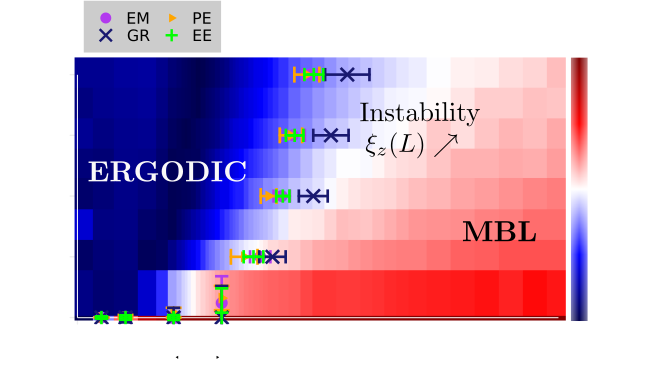
In my research, I tackle this question using state-of-the-art numerical tools and extreme value theory.
Recently, we showed numerically that the Anderson insulator in 1D can be unstable to interactions at not so weak disorder. We also showed that rare but large long-distance resonances are present up to fairly strong disorder in the random-field Heisenberg chain at high energy, and in its quasiperiodic counterpart.
Tensor networks
Tensor networks and the density matrix renormalization group have revolutionized the study of one-dimensional quantum spin systems and completely changed the landscape of available numerical tools for quantum mechanics in general.
More and more, they are also getting adapted to study disordered systems or systems with impurities.
They are also an extremely powerful tool to study 2D statistical mechanics, in particular in translation-invariant problems where they offer the possibility to trade finite-size scaling for finite-entanglement scaling, leading to new insight in old problems.
Since my PhD, I have been adapting tensor network tools to study partition functions of frustrated Ising models. As it turns out, the convergence of the algorithm depends on the formulation of the partition function.
